The Reading Rainbow
BY Zach Hines // November 9, 2007
Put down the controller for an hour or so a day and read something.
o, not Levar Burton. But the message is the same: READING IS SUPER! Since graduating college I've found reading to be a pleasant way to pass time, instead of forced learning I put off until the last possible moment. Normally I find myself reading political and historical texts, the later focusing on the crusades with the former reinforcing my filthy liberality.
Deeper literature aside, I have found another form of reading that I've come to enjoy very much, and that is books based on video games. I know, I know, they aren't exactly what you might consider literary chef d'oeuvre (that's French...I know, right?) — but they are good quick reads nonetheless. And what is more, some of them aren't half bad. Some of the books are penned by fairly well regarded authors in the science fiction and fantasy genres respectively. Typically I'll find myself reading these tomes over my lunch hours during the week, and to date (in the past 2-3 months or so) I've read the following:
- Starcraft: The Dark Templar Saga, Firstborn by Christie Golden
- Starcraft: Liberty's Crusade by Jeff Grubb
- Starcraft: Shadow of the Xel'Naga by Gabriel Mesta
- Starcraft: Speed of Darkeness by Tracy Hickman
- Starcraft Ghost, Nova by Keith R.A. DeCandido
- Starcraft: Queen of Blades by Aaron Rosenberg
- Warcraft: War of the Ancients, The Well of Eternity by Richard A. Knaak
- Warcraft: War of the Ancients, The Demon Soul by Richard A. Knaak
- Warcraft: War of the Ancients, The Sundering by Richard A. Knaak
- World of Warcraft: Cycle of Hatred by Keith R.A. DeCandido
I really like the Blizzard Entertainment games on which these stories are based. Of the above, I'd say I enjoyed Starcraft: The Dark Templar Saga, Firstborn the most. It's a very interesting story that revolves around an archaeologist and his run-in with a dying Protoss scholar. It's the first in a coming trilogy that I am very excited to continue. Another novel of note that I recently finished was Mass Effect: Revelation by Drew Karpyshyn. While I really enjoyed the books above because they expounded upon existing worlds I already enjoy, Revelation has helped develop in me an even greater longing to play Bioware's upcoming title Mass Effect. It is a space-themed RPG by the creators of Knights of the Old Republic and Jade Empire that is getting stellar early reviews for the story that it tells.
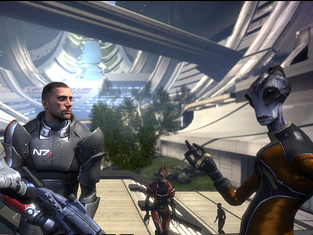
Books based on games expound
upon stories I already enjoy.The encouraging thing about this is the fact that the game's story is penned by the same author of the book itself. Since I enjoyed the book so much, I'm hoping that translates to a real enjoyment of the game. It would be nice since as of late I find RPGs failing to draw my interest within the first hour or so and thus my interest falls off. Much like a good book should hook you in the first chapter, I feel a good RPG should do the same in the first hour or so.
I think these books are nice because they are accessible for just about anyone in that they aren't brain busters. There is another kind of literature though that has to do with the gaming world as well, and that is history. Ubisoft's upcoming title Assassin's Creed has a link to literature in a different way than the above titles do, and that is that AC uses historical texts as the backbone to their game. In AC, you play as assassin Altair in the year 1191 A.D. during the Third Crusade. However, the point is that a game such as this can do so much to inspire gamers everywhere to take up reading. Let's face it, most of us are getting pretty sick of the following: a) elves and b) space heroes. That's not to say these aren't well respected niches, but they are rampant in the industry as of late.
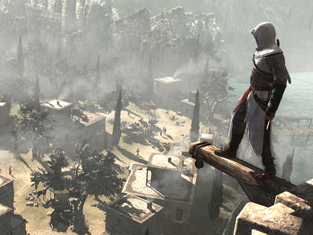
Assassin's Creed shows that the
most gripping stories are
often founded in truth.The fact is that human history is riddled with real events and real periods with enough content to make dozens, if not hundreds of games! With the exception of World War II (because it's been done to death), human history is one source I would love to see developers access for new intellectual properties in the future. That, combined with the technology this console generation has as its disposal, could do wonders for the literacy of what is often referred to as one of the most uneducated communities out there. I can attest to the truth in this in that upon first seeing this game at E3 '06, I threw myself into reading and studying about the Crusades. It's a very fascinating part of human history. A good primer on the Crusades (it seems unfair to call it that) is The Templars: The Dramatic History of the Knights Templar, the Most Powerful Military Order of the Crusades by Piers Paul Read. While this book focuses on the Knights Templar, a military order of warrior monks, it does a good job of outlining the Crusades as a whole.
As much as twits like Jack Thompson would like to vilify and condemn games and gamers as a pox on society, there are things that we can do to show the world we are not simply a community of stay-at-home-do-nothings, but educated contributors to society. What's the point here? Read! Put down the controller for an hour or so a day and read something. Whether it's fact or fiction, put your brain to work. Gamers are not stupid. Prove it. You never know, someday you might hear, "You can't have your book until you finish your game."
Whoa...dude...wouldn't that be a trip?
© 2007 Game and Player. All rights reserved.